 yetone
d43b228463
provision, resolve and exec answer the workspace's path, and a tool
result goes to the vendor in the agent's next request. With the default
root ~/.magpie-layerfs every provision named magpie upstream.

The default root is now ~/.layerfs-tools. A ~/.magpie-layerfs made by
0.7.2 or earlier is renamed to it once, at the first backend made, and
a link is left at the old path, so a session still holding an old
workspace path keeps working. A legacy root that is itself a link (the
user's own setup) is used where it is, as is one the rename is refused
on. MAGPIE_LAYERFS_HOME set by the user is unchanged. A second host
racing the rename finds the new root and uses it.

Run, in a sandbox HOME:
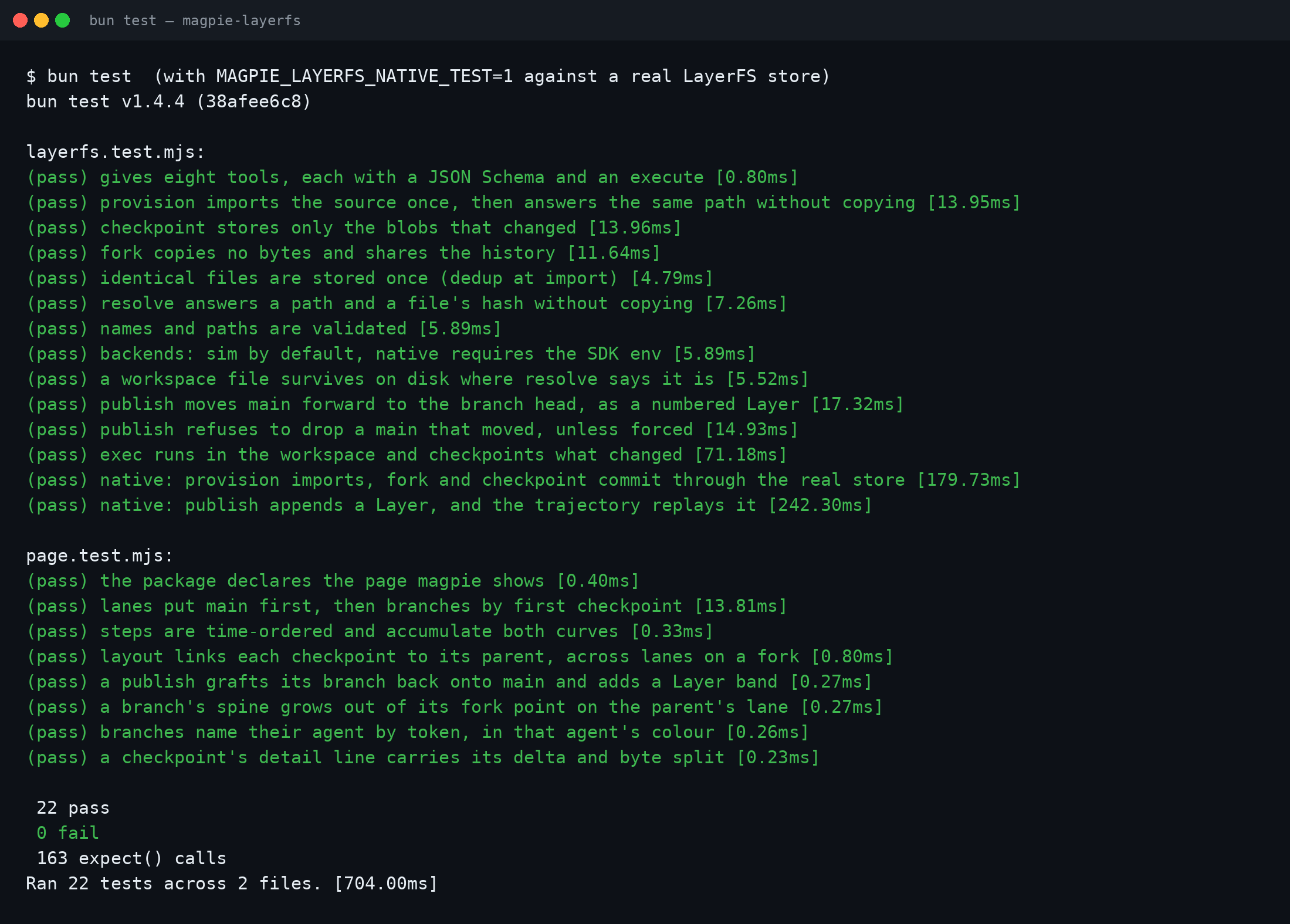
- bun test packages/layerfs: 53 pass, 0 fail. bun scripts/check.mjs
  layerfs: ok.
- The three #360 tests against the old default (defaultRoot answering
  ~/.magpie-layerfs): 2 of them red, the third (a user's link) is
  unchanged behaviour.
- Through magpie's real plugin host (origin/main 4dfd88206,
  plugin.Add of this package + plugin.RunTool "provision" in a
  testenv sandbox HOME): a fresh home answers
  ~/.layerfs-tools/workspaces/demo/main and makes nothing at the old
  name; a home with a ~/.magpie-layerfs holding a marker answers the
  new path, the marker is under ~/.layerfs-tools, and ~/.magpie-layerfs
  is a symlink.

Not tried: Windows (the link is a junction there), and moving a root
while an agent's exec runs in it.
288 lines
16 KiB
Markdown
288 lines
16 KiB
Markdown
# LayerFS for Magpie
|
||
|
||
[LayerFS](https://github.com/Ephemeral-AI-Lab/layerfs) workspaces for every
|
||
agent [magpie](https://usemagpie.ai) connects: instead of each agent copying
|
||
a project tree to work on it, agents share one durable, deduplicated history
|
||
and work through **stable filesystem paths**. Forking a branch for a
|
||
parallel agent copies **no file bytes**; a checkpoint stores **only what
|
||
changed**; any agent can resolve, read and build on what the others
|
||
committed.
|
||
|
||
给每个 agent 的 LayerFS 工作区:多个 agent 共享一份可去重的持久历史,而不是
|
||
各自复制整棵项目树。给并行 agent 开分支不复制任何文件字节;存检查点只写
|
||
变化的部分;路径稳定,任何 agent 都能定位、读取并接续其他 agent 的提交。
|
||
|
||
```sh
|
||
magpie plugin add @magpie-community/tools-layerfs
|
||
magpie plugin # lists layerfs_provision, layerfs_checkpoint, ...
|
||
```
|
||
|
||
## Tools
|
||
|
||
Served on magpie's MCP server as `layerfs_<tool>`:
|
||
|
||
| Tool | What it does |
|
||
|---|---|
|
||
| `provision` | Gives the agent a workspace for a project branch and answers the path to work in. The first provision imports the source directory — a required argument, the directory the user chose for the project — as the project's first checkpoint; later provisions of the same branch answer the same path without copying the tree again. |
|
||
| `checkpoint` | Saves the workspace's state on its branch, storing only the blobs the store has not seen; answers added / modified / deleted counts and the new-bytes vs saved-bytes accounting. |
|
||
| `fork` | Forks a branch for a parallel agent: a pointer at an existing checkpoint, ready immediately, 0 bytes copied. |
|
||
| `publish` | Publishes a branch's head as main's new Layer, so finished work becomes what new work forks from. Guarded: main's head must be in the branch's history, so a publish can only move main forward — if main moved on its own, the publish is refused (a real dsh run lost main's 238 tests to a stale publish; this is that lesson, encoded). `force: true` overwrites deliberately and reports what it replaced. |
|
||
| `exec` | Runs a shell command in a branch's workspace and checkpoints whatever it changed as one commit — the dsh shape, where every bash call is mount, run, commit. A no-change command commits nothing; a failing command's changes are still checkpointed, with its exit code reported. **Disabled by default** (see Safety defaults): it runs only when the user has opted in. |
|
||
| `history` | Lists a branch's checkpoints, newest first, with each one's logical tree size and the bytes it actually stored. |
|
||
| `resolve` | Resolves a project / branch / file to a real filesystem path, its checkpoint and content hash — an O(1) lookup, no copying. |
|
||
| `status` | Backend in use, projects and branches held, and the storage accounting: logical bytes of all checkpoints vs bytes the store occupies. |
|
||
|
||
Only the workspace path is persistent. Every workspace carries two
|
||
scratch directories, `.tmp/` and `.cache/`, created at provision;
|
||
`exec` runs commands with `TMPDIR` and `XDG_CACHE_HOME` redirected at
|
||
them, so toolchains keep their temporary files and caches inside the
|
||
workspace instead of the host's real `/tmp`. Both directories are
|
||
workspace-local scratch: checkpoints and publishes never capture them,
|
||
and they live and die with the workspace directory itself. Files a
|
||
command writes to the host's real `/tmp` are likewise outside LayerFS
|
||
management — if it matters, it belongs in the workspace.
|
||
|
||
## Backend
|
||
|
||
- **sim** — a local content-addressed store implementing the LayerFS
|
||
model: immutable blobs named by SHA-256, branches as manifest
|
||
pointers, checkpoints as deduplicated manifests, under
|
||
`MAGPIE_LAYERFS_HOME` (default `~/.layerfs-tools`; a
|
||
`~/.magpie-layerfs` from 0.7.2 or earlier is moved there once, with a
|
||
link left at the old path). It runs anywhere, which is what the tests
|
||
and the benchmark below use.
|
||
|
||
**This package is sim-only.** The native backend — the real LayerFS
|
||
through its JavaScript SDK — is developed in the standalone repo,
|
||
[Mola-maker/magpie-layerfs](https://github.com/Mola-maker/magpie-layerfs),
|
||
and is not part of this package: shipping it here needs a pinned,
|
||
integrity-checked npm dependency, and `@layerfs/sdk` is not
|
||
published to npm, so there is no version to pin. It returns in a
|
||
follow-up PR once the SDK is published. Asking for it
|
||
(`MAGPIE_LAYERFS_BACKEND=native`, `MAGPIE_LAYERFS_NATIVE=1`, or the
|
||
old `"native"` plugin option) is an explicit error that says so.
|
||
|
||
`MAGPIE_LAYERFS_BACKEND=auto|sim` selects explicitly; both mean sim
|
||
here.
|
||
|
||
## Safety defaults
|
||
|
||
magpie serves plugin tools on its MCP server to any caller holding a
|
||
gateway key, and the plugin host runs with the user's rights — so the
|
||
defaults here are set for that room, not for a private library:
|
||
|
||
- **`provision`'s `source` is required.** There is no default: an
|
||
earlier version defaulted it to the host's `directory`, which in
|
||
magpie is the *config* directory (`~/.config/magpie`) — it holds
|
||
`plugin-auth.json`, every signed-in plugin's token. The config
|
||
directory, the credential stores (`~/.ssh`, `~/.aws`, `~/.gnupg`),
|
||
the home directory, the filesystem root, and the plugin's own store
|
||
are refused as a source — as the source, inside it, or containing
|
||
it. The comparison runs on real paths (`realpathSync`, case-folded),
|
||
so neither a symlink pointing at a refused directory nor a
|
||
case-variant spelling of one (`~/.Config/Magpie`, `~/.AWS`) gets
|
||
past it.
|
||
- **Secret-shaped files never enter the store from an import**:
|
||
`.git`, `.env*`, private keys (`id_rsa`, `id_ed25519`, `*.pem`,
|
||
`*.key`, …), `.ssh`, `.aws`. The import skips them and reports how
|
||
many. Imports are also bounded (20,000 files / 512 MiB) and fail
|
||
loudly past the limit instead of sweeping a disk.
|
||
- **The store is private.** Its root and directories are created
|
||
`0700`, its record files `0600`, whatever the umask says; a file's
|
||
own mode is preserved through the store (a `0600` file is stored
|
||
and materialized as `0600`).
|
||
- **`exec` is disabled by default.** It runs a shell with the plugin
|
||
host's privileges; a model key should not silently become host
|
||
shell access. The user enables it with the plugin's `"exec"`
|
||
option (set to `true` in magpie's plugin options) or
|
||
`MAGPIE_LAYERFS_EXEC=1` in the host's environment.
|
||
- **Re-provisioning never wipes a workspace.** When a branch has
|
||
moved since its workspace was materialized, provision keeps the
|
||
workspace's files and reports `stale: true` instead of deleting
|
||
uncheckpointed work.
|
||
|
||
## Benchmark
|
||
|
||
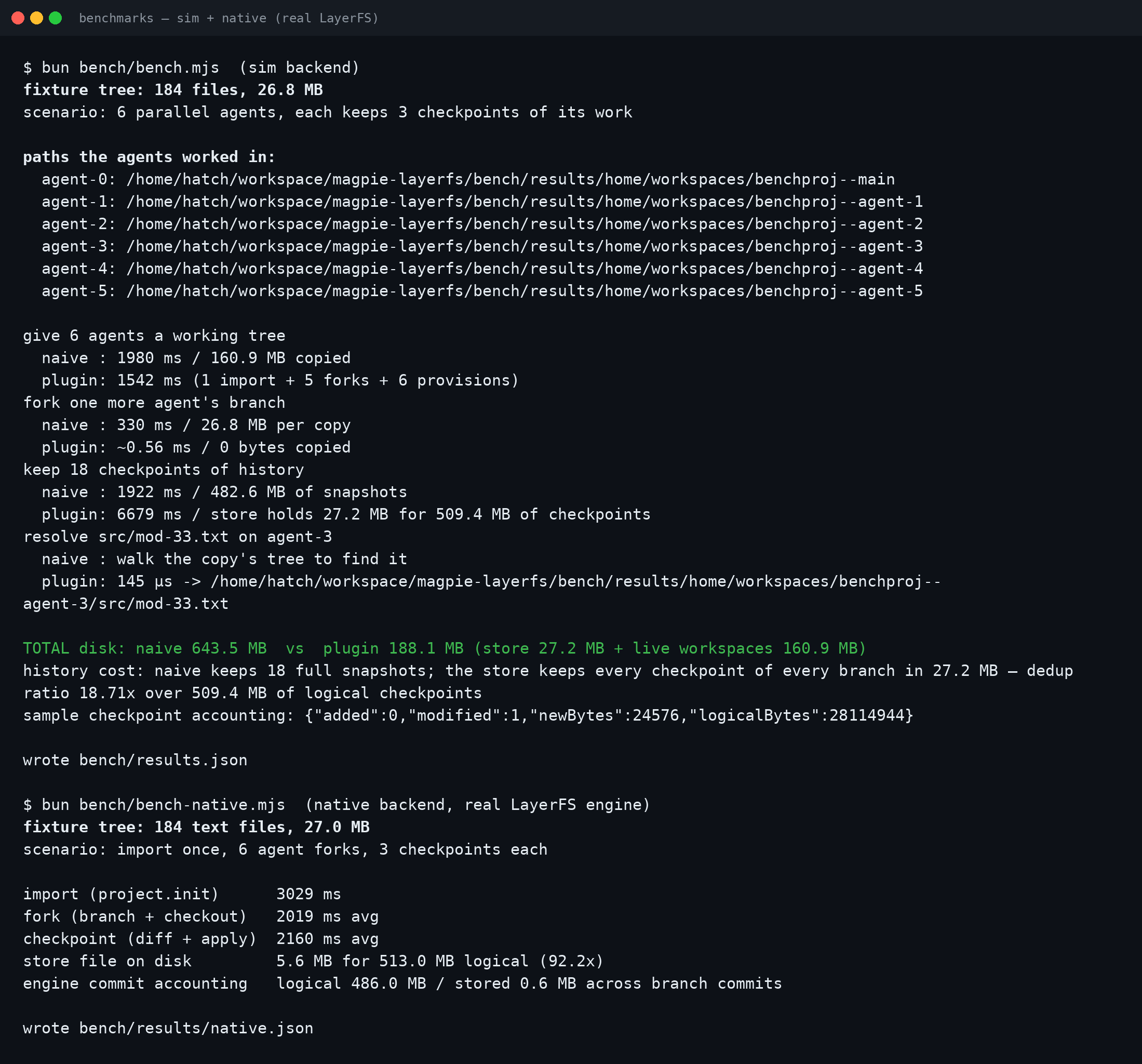
[`bench/bench.mjs`](https://github.com/Mola-maker/magpie-layerfs/blob/main/bench/bench.mjs)
|
||
(run from a checkout of this repo) — a 184-file, 26.8 MB project; 6
|
||
parallel agents, each keeping 3 checkpoints (sim backend, this machine):
|
||
|
||
| | naive copies | this plugin |
|
||
|---|---|---|
|
||
| fork one more agent | 321 ms, 26.8 MB copied | **~1 ms, 0 bytes** |
|
||
| keep 18 checkpoints | 482.6 MB of snapshots | **27.2 MB** of store for 509.4 MB of logical checkpoints (**18.7× dedup**) |
|
||
| resolve a file path | walk the copy's tree | **138 µs**, with its checkpoint + SHA-256 |
|
||
| total disk for the run | 643.5 MB | **188.1 MB** (store + the 6 live workspaces) |
|
||
|
||
|
||
|
||
|
||
Honest limits: a first provision still materializes the tree once, and the
|
||
sim backend rehashes the tree at each checkpoint (the native engine tracks
|
||
changes through its daemons instead). What the plugin removes is the
|
||
per-agent copy, the per-snapshot copy, and the bytes they waste — the
|
||
engine's own benchmarks are at
|
||
[layerfs.ai/benchmarks](https://layerfs.ai/benchmarks/).
|
||
|
||
The same scenario against the real engine (the native backend, in
|
||
the standalone repo): the engine's store file held **5.6 MB for
|
||
513 MB of logical checkpoints** on a compressible text fixture —
|
||
the sim fixture above is random bytes, the incompressible extreme, so
|
||
read the two ratios as the ends of a range, not a single number.
|
||
|
||
## The page: watch the trajectory
|
||
|
||
The package also declares a magpie page, **LayerFS trajectory**
|
||
(轨迹), which replays how the agents' worktrees grew, drawn the way
|
||
LayerFS's own History picture draws them: main is the green middle
|
||
bough, each branch a bough of its own, a checkpoint a badge bearing
|
||
its agent's own icon — the marks magpie itself ships for them, in
|
||
that agent's colour — a fork a split, and a publish a graft back
|
||
onto main that adds a Layer band (L0, L1, …). Two running totals
|
||
carry the argument — what those checkpoints would have cost as
|
||
plain copies against what the deduplicated store actually wrote,
|
||
with a store.stats line in LayerFS's own accounting words. Play it,
|
||
scrub it, click a badge for its checkpoint's message and byte
|
||
split, or click a branch's name tag to focus that branch alone:
|
||
that is what the plugin does for an agent's edits, made visible.
|
||
|
||
The page is drawn in magpie's own design language and built the way
|
||
magpie builds pages — plain HTML, CSS and scripts, no build step and
|
||
no dependencies, styled by the host's `--magpie-*` theme tokens with
|
||
its tiles, seg controls and indigo accent. The replay runs on
|
||
requestAnimationFrame through magpie's own `--ease` curve
|
||
(cubic-bezier(.2,.8,.2,1)): the boughs draw themselves as the
|
||
playhead passes, each badge lands with a pulse while its icon
|
||
draws its own outline and fills in, a publish pops its Layer badge
|
||
(L1, L2, …) onto main, and the stat tiles count up with the same
|
||
easing; with reduced motion preferred, the page simply shows the
|
||
finished picture, every icon fully drawn.
|
||
|
||
A magpie page cannot read plugin-private data: its sandbox forbids
|
||
fetch, and the bridge's reads are a fixed host list (`usage:summary`,
|
||
`providers:list`) with no entry a plugin can serve its own data
|
||
through. So the page animates the sample bundled with it —
|
||
`page/trajectory.js`, a labeled recording from the benchmark scenario
|
||
(one project, six agents, three checkpoints each), a package asset
|
||
that nothing rewrites at runtime. The trajectory itself is computed
|
||
on demand from the store's records whenever it is asked for
|
||
(`backend.trajectory()`; `tools/gen-trajectory.mjs` uses it to make
|
||
the sample). No recording file is maintained per tool call: an
|
||
earlier version refreshed one in the store after every call, which
|
||
cost a branch-chain walk per call — growing with the project's
|
||
history — for a file the page cannot read, so the refresh was
|
||
removed in 0.7.1. The page declares no `magpie.read` permissions,
|
||
and its test asserts it asks for none.
|
||
|
||
## Develop
|
||
|
||
From a checkout of
|
||
[magpie-community/plugins](https://github.com/magpie-community/plugins),
|
||
in `packages/layerfs`:
|
||
|
||
```sh
|
||
bun test # the suite (bun:test): tools end to end, plus the page's layout math
|
||
```
|
||
|
||
The benchmark above and the sample-trajectory generator live in the
|
||
standalone repo,
|
||
[Mola-maker/magpie-layerfs](https://github.com/Mola-maker/magpie-layerfs),
|
||
which is also where the native backend is developed.
|
||
|
||
Zero runtime dependencies; the arguments are JSON Schema, like the other
|
||
tools packages. MIT.
|
||
|
||
## Changes in 0.7.1
|
||
|
||
The second round of the PR #318 review — the holes it found in
|
||
0.7.0's own new code, plus its smaller items:
|
||
|
||
- **This package is sim-only.** The native backend was removed from
|
||
the magpie-community package (the review's condition for keeping
|
||
it — a pinned, integrity-checked npm dependency — cannot exist
|
||
while `@layerfs/sdk` is not on npm). It lives in the standalone
|
||
repo and returns in a follow-up PR once the SDK is published with
|
||
a version to pin; asking for it here is an explicit error.
|
||
`package.json`'s `repository` now names this repo, with
|
||
`"directory": "packages/layerfs"`, like every other package here.
|
||
- **The source guard compares real paths now.** 0.7.0 compared
|
||
`resolve()`d strings, which a symlink to a refused directory — or
|
||
a case-variant spelling of one on a case-insensitive volume —
|
||
walked straight past (the review imported `plugin-auth.json`
|
||
through `~/.Config/Magpie` and through a symlink). Both sides are
|
||
canonicalized with `realpathSync` and case-folded; refused roots
|
||
that do not exist are canonicalized through their nearest existing
|
||
ancestor. Regression tests cover the symlink and the case variant,
|
||
unit-level and end to end.
|
||
- **Breaking on-disk change: workspaces moved, branch encoding
|
||
widened.** Workspaces now live at `workspaces/<project>/<encoded
|
||
branch>` — the flat `<project>--<branch>` name was not injective
|
||
(project `a` branch `b--c` and project `a--b` branch `c` shared one
|
||
directory, and a checkpoint crossed the projects). The branch
|
||
encoder now percent-encodes every character outside `[a-z0-9._-]`,
|
||
uppercase included, so `Main` and `main` no longer share a head
|
||
file or a workspace on case-insensitive volumes either. Stores are
|
||
**not migrated**: branch head files are unchanged for names the old
|
||
encoder already spelled the same way (lowercase, `_`, `-`, `.`,
|
||
and `/`→`%2F`); a branch whose name contains uppercase or `%`
|
||
keeps its commits but its old head file (`branches/Main.json`)
|
||
and old workspace (`workspaces/<project>--Main`) are not picked
|
||
up — re-fork such branches, and remove the old workspace
|
||
directories by hand.
|
||
- **No per-call trajectory refresh.** The `trajectory.json` the
|
||
tools maintained in the store after every call is gone: keeping it
|
||
current cost a walk of the touched branch's whole chain per call,
|
||
for a file the page cannot read. `trajectory()` still builds the
|
||
same data on demand.
|
||
- **`exec`'s plumbing**: stdin is closed (a command reading it gets
|
||
EOF instead of waiting out the timeout), the child runs detached
|
||
in its own process group and a timeout kills the group, and the
|
||
call resolves on `exit` plus a short drain instead of `close` —
|
||
a background child holding the stdout pipe can no longer hold the
|
||
call open past its shell.
|
||
- **Manifests are counted.** `storedBytes`/`dedupRatio` now include
|
||
the commit records — each checkpoint's full manifest — which for
|
||
a wide tree are a real share of the store (the review measured
|
||
128 MB of manifests for 200 checkpoints of a 5,000-file tree,
|
||
previously uncounted, under a description claiming history "costs
|
||
little more than the changes themselves"; the description now
|
||
states the real cost model). Stores written before 0.7.1 keep
|
||
their incremental record, which undercounts by the records written
|
||
before this version until the record is rebuilt (delete
|
||
`accounting.json` to force the rebuild walk).
|
||
- The page's README images are pinned to a commit instead of the
|
||
moving `main`.
|
||
|
||
## Changes in 0.7.0
|
||
|
||
A safety pass over the whole package (prompted by the PR #318 review):
|
||
|
||
- `provision` requires `source` explicitly and refuses magpie's config
|
||
directory and the credential stores as sources; imports skip
|
||
secret-shaped files (sim) or refuse them (native), and are bounded.
|
||
- `exec` is off by default; the user's `"exec"` plugin option or
|
||
`MAGPIE_LAYERFS_EXEC=1` turns it on.
|
||
- The native backend is off by default (the `"native"` option or
|
||
`MAGPIE_LAYERFS_NATIVE=1`) and runs entirely in a child process
|
||
(`native-worker.mjs`); the host process imports no SDK and shares no
|
||
`LAYERFS_*` environment writes.
|
||
- A native checkpoint no longer deletes binaries it skipped at
|
||
checkout; re-provisioning a moved native branch reports `stale`
|
||
instead of wiping the workspace; native publish refuses when the
|
||
fork point or main's top Layer is unknown.
|
||
- The store and workspaces are `0700`, record files `0600`, and file
|
||
modes are preserved through the sim store.
|
||
- The recorded trajectory lives in the store (`trajectory.json`),
|
||
refreshed per affected project; the page's bundled file is a static
|
||
sample, and running the test suite modifies no package file.
|
||
- **Breaking on-disk change**: branch head files and workspace
|
||
directories now percent-encode `/` (`feat/x` → `feat%2Fx`), so slash
|
||
branches and `feat__x` no longer collide and slash branches list
|
||
correctly. Stores written by 0.6.x keep working for non-slash
|
||
branches; a slash branch's old head file (`branches/feat/x.json`)
|
||
and workspace (`feat__x`) are not migrated — re-fork slash branches.
|
||
- The page gained Japanese and Traditional Chinese string tables
|
||
(matching its declared titles), a magpie-style project menu in
|
||
place of the native `<select>`, and a branch-colour dot on the
|
||
detail card in place of the coloured edge.
|