 yetone
319b0a6459
AlanWang1027713 on X (magpie v0.1.4026, macOS): Plugins -> LayerFS
轨迹 stays on "Connecting to the local trajectory service…".

The page's boot.js jumps its frame to the host's service on 43717, and
the service started only once a store with a project existed. With no
store the jump is refused. The README said the frame then shows the
browser's refused-to-connect page; that is Chromium. A WebKit frame
(magpie's window on macOS and Linux) keeps the old document when its
jump is refused, so it said Connecting for good.

The service now starts when the host loads, store or no store. With no
store (or an empty projects folder) it answers an empty recording
without building the backend, so nothing is written under ~ until a
tool call makes the first project. The empty state now reloads itself
every 5s like the full page, so the first provision shows up without
reopening the page. The retry on a held port no longer waits for a
store, and the store-race recheck it needed is gone.

Run on mote (Bun 1.4.2, temp HOME):
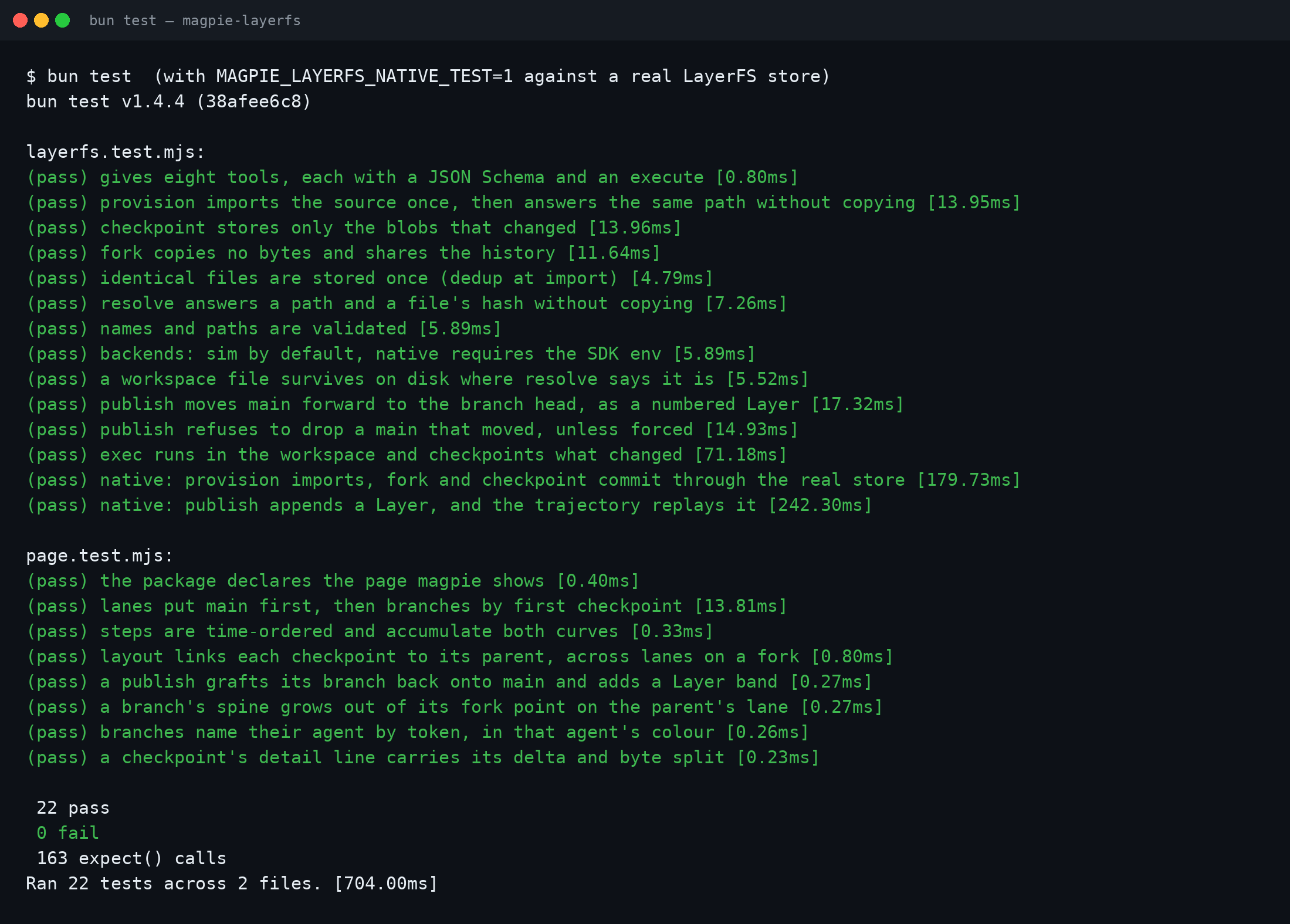
- bun test packages/layerfs: 69 pass, 0 fail. bun scripts/check.mjs: 0.
- Broken by hand: 0.10.1's index.mjs and app.js turn the two new
  tests red (the no-store service test and the empty-state reload).
- Real browsers (Playwright 1.62.0): a sandboxed frame doing boot.js's
  jump against a no-store host. 0.10.1: WebKit's frame stays on
  "Connecting to the local trajectory service…", Chromium's shows
  chrome-error. 0.10.2: both show the zh empty state
  ("还没有记录到轨迹…").

Not tried: the page inside the real magpie window with the plugin
installed.
24 KiB
LayerFS for Magpie
LayerFS workspaces for every agent magpie connects: instead of each agent copying a project tree to work on it, agents share one durable, deduplicated history and work through stable filesystem paths. Forking a branch for a parallel agent copies no file bytes; a checkpoint stores only what changed; any agent can resolve, read and build on what the others committed.
给每个 agent 的 LayerFS 工作区:多个 agent 共享一份可去重的持久历史,而不是 各自复制整棵项目树。给并行 agent 开分支不复制任何文件字节;存检查点只写 变化的部分;路径稳定,任何 agent 都能定位、读取并接续其他 agent 的提交。
magpie plugin add @magpie-community/tools-layerfs
magpie plugin            # lists layerfs_provision, layerfs_checkpoint, ...
Tools
Served on magpie's MCP server as layerfs_<tool>:
| Tool | What it does |
|---|---|
provision |
Gives the agent a workspace for a project branch and answers the path to work in. The first provision imports the source directory — a required argument, the directory the user chose for the project — as the project's first checkpoint; later provisions of the same branch answer the same path without copying the tree again. |
checkpoint |
Saves the workspace's state on its branch, storing only the blobs the store has not seen; answers added / modified / deleted counts and the new-bytes vs saved-bytes accounting. |
fork |
Forks a branch for a parallel agent: a pointer at an existing checkpoint, ready immediately, 0 bytes copied. |
publish |
Publishes a branch's head as main's new Layer, so finished work becomes what new work forks from. Guarded: main's head must be in the branch's history, so a publish can only move main forward — if main moved on its own, the publish is refused (a real dsh run lost main's 238 tests to a stale publish; this is that lesson, encoded). force: true overwrites deliberately and reports what it replaced. |
exec |
Runs a shell command in a branch's workspace and checkpoints whatever it changed as one commit — the dsh shape, where every bash call is mount, run, commit. A no-change command commits nothing; a failing command's changes are still checkpointed, with its exit code reported. Disabled by default (see Safety defaults): it runs only when the user has opted in. |
history |
Lists a branch's checkpoints, newest first, with each one's logical tree size and the bytes it actually stored. |
resolve |
Resolves a project / branch / file to a real filesystem path, its checkpoint and content hash — an O(1) lookup, no copying. |
status |
Backend in use, projects and branches held, and the storage accounting: logical bytes of all checkpoints vs bytes the store occupies. |
Only the workspace path is persistent. Every workspace carries two
scratch directories, .tmp/ and .cache/, created at provision;
exec runs commands with TMPDIR and XDG_CACHE_HOME redirected at
them, so toolchains keep their temporary files and caches inside the
workspace instead of the host's real /tmp. Both directories are
workspace-local scratch: checkpoints and publishes never capture them,
and they live and die with the workspace directory itself. Files a
command writes to the host's real /tmp are likewise outside LayerFS
management — if it matters, it belongs in the workspace.
Backend
- sim — a local content-addressed store implementing the LayerFS
model: immutable blobs named by SHA-256, branches as manifest
pointers, checkpoints as deduplicated manifests, under
MAGPIE_LAYERFS_HOME(default~/.layerfs-tools; a~/.magpie-layerfsfrom 0.7.2 or earlier is moved there once, with a link left at the old path). It runs anywhere, which is what the tests and the benchmark below use.
This package is sim-only. The native backend — the real LayerFS
through its JavaScript SDK — is developed in the standalone repo,
Mola-maker/magpie-layerfs,
and is not part of this package: shipping it here needs a pinned,
integrity-checked npm dependency, and @layerfs/sdk is not
published to npm, so there is no version to pin. It returns in a
follow-up PR once the SDK is published. Asking for it
(MAGPIE_LAYERFS_BACKEND=native, MAGPIE_LAYERFS_NATIVE=1, or the
old "native" plugin option) is an explicit error that says so.
MAGPIE_LAYERFS_BACKEND=auto|sim selects explicitly; both mean sim
here.
Safety defaults
magpie serves plugin tools on its MCP server to any caller holding a gateway key, and the plugin host runs with the user's rights — so the defaults here are set for that room, not for a private library:
provision'ssourceis required. There is no default: an earlier version defaulted it to the host'sdirectory, which in magpie is the config directory (~/.config/magpie) — it holdsplugin-auth.json, every signed-in plugin's token. The config directory, the credential stores (~/.ssh,~/.aws,~/.gnupg), the home directory, the filesystem root, and the plugin's own store are refused as a source — as the source, inside it, or containing it. The comparison runs on real paths (realpathSync, case-folded), so neither a symlink pointing at a refused directory nor a case-variant spelling of one (~/.Config/Magpie,~/.AWS) gets past it.- Secret-shaped files never enter the store from an import:
.git,.env*, private keys (id_rsa,id_ed25519,*.pem,*.key, …),.ssh,.aws. The sim backend skips them and reports how many. Imports are also bounded (20,000 files / 512 MiB) and fail loudly past the limit instead of sweeping a disk. - The store is private. Its root and directories are created
0700, its record files0600, whatever the umask says; a file's own mode is preserved through the sim store (a0600file is stored and materialized as0600). execis disabled by default. It runs a shell with the plugin host's privileges; a model key should not silently become host shell access. The user enables it with the plugin's"exec"option (set totruein magpie's plugin options) orMAGPIE_LAYERFS_EXEC=1in the host's environment.- Re-provisioning a moved branch keeps the workspace. When a
branch has moved since its checkout, re-provisioning keeps the
workspace's files and reports
stale: trueinstead of wiping the directory.
Benchmark
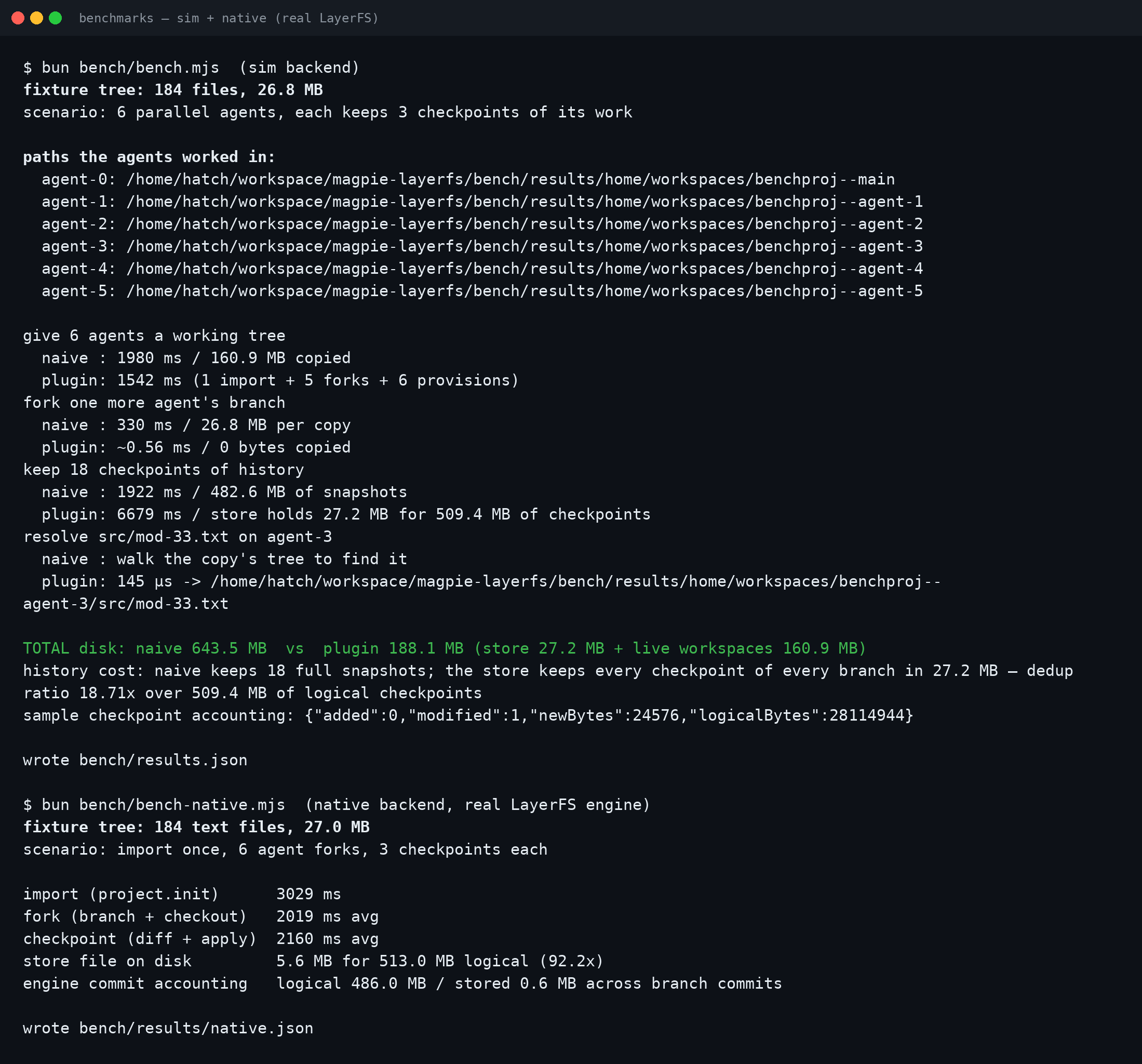
bench/bench.mjs
(run from a checkout of this repo) — a 184-file, 26.8 MB project; 6
parallel agents, each keeping 3 checkpoints (sim backend, this machine):
| naive copies | this plugin | |
|---|---|---|
| fork one more agent | 321 ms, 26.8 MB copied | ~1 ms, 0 bytes |
| keep 18 checkpoints | 482.6 MB of snapshots | 27.2 MB of store for 509.4 MB of logical checkpoints (18.7× dedup) |
| resolve a file path | walk the copy's tree | 138 µs, with its checkpoint + SHA-256 |
| total disk for the run | 643.5 MB | 188.1 MB (store + the 6 live workspaces) |
Honest limits: a first provision still materializes the tree once, and the sim backend rehashes the tree at each checkpoint (the native engine tracks changes through its daemons instead). What the plugin removes is the per-agent copy, the per-snapshot copy, and the bytes they waste — the engine's own benchmarks are at layerfs.ai/benchmarks.
Against the real engine
(bench/bench-native.mjs,
native backend, same scenario, generated-text fixture of 184 files /
27.0 MB): import
3.6 s once; a fork plus its checkout 1.8 s (the branch itself is
metadata; the checkout pays the file reads); a checkpoint 1.9 s (the
checkout diff reads the branch back through the fs surface, then one
fs.apply lands it); the engine's store file held 5.6 MB for
513 MB of logical checkpoints on this compressible text fixture —
the sim fixture above is random bytes, the incompressible extreme, so
read the two ratios as the ends of a range, not a single number.
The page: watch the trajectory
The package also declares a magpie page, LayerFS trajectory (轨迹), which replays how the agents' worktrees grew, drawn the way LayerFS's own History picture draws them: main is the green middle bough, each branch a bough of its own, a checkpoint a badge bearing its agent's own icon — the marks magpie itself ships for them, in that agent's colour — a fork a split, and a publish a graft back onto main that adds a Layer band (L0, L1, …). Two running totals carry the argument — what those checkpoints would have cost as plain copies against what the deduplicated store actually wrote, with a store.stats line in LayerFS's own accounting words. Play it, scrub it, click a badge for its checkpoint's message and byte split, or click a branch's name tag to focus that branch alone: that is what the plugin does for an agent's edits, made visible.
The page is drawn in magpie's own design language and built the way
magpie builds pages — plain HTML, CSS and scripts, no build step and
no dependencies, styled by the host's --magpie-* theme tokens with
its tiles, seg controls and indigo accent. The replay runs on
requestAnimationFrame through magpie's own --ease curve
(cubic-bezier(.2,.8,.2,1)): the boughs draw themselves as the
playhead passes, each badge lands with a pulse while its icon
draws its own outline and fills in, a publish pops its Layer badge
(L1, L2, …) onto main, and the stat tiles count up with the same
easing; with reduced motion preferred, the page simply shows the
finished picture, every icon fully drawn.
A magpie page cannot fetch, and the bridge's reads are a fixed host
list (usage:summary, providers:list) with no entry a plugin can
serve its own data through — but magpie lets a page navigate its
frame elsewhere, and pulls a plugin's host part up the moment its
page is requested, waiting up to 7 seconds for it (pageHost /
plugin.Warm). So the page's live channel is the host's own
localhost-only service (page-service.mjs), the way page-chat
serves its chat page:
- The installed page only jumps.
page/index.htmldoes one thing: it reads the port from the plugin's options (pagePort, default 43717) andlocation.replaces its frame tohttp://127.0.0.1:<port>/. The install's folder is never renamed, linked, or written into. The service starts when the host loads, store or no store; a user with no store gets the page's empty state and nothing written anywhere. - The service returns the page with its data inside. Each
request rebuilds
backend.trajectory()on demand and answers one route, GET /, as HTML: the trajectory UI with the recording embedded as<script type="application/json" id="data">, which the page reads from the DOM — never by fetch. The page reloads itself every few seconds, keeping its view across each reload (the project, the scroll, and the replay position ride inlocation.hash), so the picture stays live. With no store, or a store with no recorded checkpoints yet, the page shows its empty state and keeps reloading, so the first provision appears on its own. - The service recovers after a host handover. A retired plugin host may still hold the page port while finishing a request. The replacement retries a failed bind automatically, starting after one second and backing off to at most 30 seconds. A closed listener is retried too; concurrent tool calls share one startup attempt. Retries write nothing and do not keep an otherwise finished host alive. An already refused frame may need a reload after the listener recovers; neither the gateway nor an agent task needs restarting.
- The service is closed to other sites. It emits no CORS
headers and refuses any request carrying an Origin (a sandboxed
iframe's fetch sends
Origin: null); it serves no.jsdata file another site could<script src>— onlytext/htmlwithX-Content-Type-Options: nosniff; and it checks Host, answering only127.0.0.1:<port>andlocalhost:<port>, so a DNS-rebinding name is refused. Another site can at most frame the page; it cannot read it. - An Agent activity table under the replay lists every recorded tool call — the calling agent, the tool, the project, the branch and the time, newest last. With no recorded calls the table gives way to an empty note; all four locales carry the strings.
backend.trajectory() itself is computed on demand from the store's
records whenever it is asked for (tools/gen-trajectory.mjs uses it
to make the sample). No recording file is maintained in the store: an
earlier version refreshed one in the store after every call, which
cost a branch-chain walk per call — growing with the project's
history — for a file the page cannot read, so the refresh was removed
in 0.7.1. The page declares no magpie.read permissions, and its
test asserts it asks for none.
Develop
From a checkout of this repo (the registry package ships only the runtime files):
bun test                 # the suite (bun:test): tools end to end, plus the page's layout math
bun bench/bench.mjs      # the benchmark above; writes bench/results.json
node tools/gen-trajectory.mjs   # regenerate the page's bundled sample trajectory
Zero runtime dependencies; the arguments are JSON Schema, like the other tools packages. MIT.
Changes in 0.10.2
The page no longer hangs on "Connecting to the local trajectory service…" before the first project. Up to 0.10.1 the service started only once a store existed, so the page's jump to it was refused; a WebKit frame (magpie on macOS and Linux) keeps the old document when its jump is refused, so the page said Connecting for good. The service now starts when the host loads. With no store it serves the page's empty state without building the backend, so nothing is written under ~ until a tool call makes the first project, and the empty page reloads itself every 5 seconds until that project appears.
Changes in 0.10.1
The page service now survives Magpie replacing its plugin host. A retired host can keep port 43717 until its in-flight request finishes; the replacement now retries a failed bind with bounded backoff instead of remembering a server that never listened. Once the port is free, the page recovers without another tool call or a gateway restart. A closed listener is restarted too, and concurrent calls share one startup check. Retries only begin after a project exists, so an empty store still writes nothing and starts no polling.
Changes in 0.10.0
The page's live channel comes back, out of the plugin's own folder. The 0.9.0 review was right that nothing may write into the installed package's folder — an update replaces that folder, two hosts with one install race on the same file, and an install can be read-only — but its conclusion, a page that only ever shows the bundled sample, threw away the real trajectory every desktop had been watching. This version answers both sides at once, the way page-chat serves its page:
- The host serves the page itself. The installed
page/is never renamed, linked, or written into:page/index.htmlonly navigates its frame to a localhost-only service the host starts (page-service.mjs, portpagePort, default 43717), which returns the trajectory UI with the live recording embedded in the HTML. The page reloads itself every few seconds, so the picture stays live without any file channel. - The page gains an Agent activity table — every recorded tool call, with the calling agent, the tool, the project, the branch and the time — so each round's work is visible per agent, not only as commits on a graph.
- The service starts only once a store exists (two read-only gates: a projects folder that holds entries, and a non-empty answer from the backend that will serve the calls), so an upgrade shows the user's real work on the first open, and a user with no store gets no service and nothing written anywhere.
startPageServicelives inpage-service.mjs, not the entry module: the plugin host takes every function the entry exports for an OpenCode plugin factory and calls it at load, so the entry exportsLayerfsToolsalone (the standalone repo shipped 0.10.0 with the helper in the entry and the whole plugin failed to load — this is that lesson, applied here from the start).
Changes in 0.9.0
The registry package is sim-only now. The native backend — the
standalone repo's LayerFS 1.1.0 port, with the SDK split into
@layerfs/agent, @layerfs/backend and @layerfs/runtime, the
LayerFS.open / LayerFS.init factories and the child-process
worker — stays in the standalone repo until the SDK is published
to npm and this package can pin it; the registry review asked for
the native path to stay out until then, so native-worker.mjs
and the fake SDK are gone from this package, the "native" plugin
option is gone, and a native request is refused instead of
silently running sim.
The page's live file is gone with it: the registry review asked
for no writes into the installed plugin's folder, so the tools no
longer write page/trajectory-live.js at runtime and the page is
back to the bundled sample (the 0.7.1 position — a magpie page
cannot read plugin-private data, and the bridge's reads are a
fixed host list). The live trajectory stays available through the
tools and through backend.trajectory(), which now caches every
commit's summary (everything but the manifest, which it never
uses) per project/id: a rebuild reads only commits it has never
seen, and a rebuild with nothing new reads no records at all (a
test counts the reads to pin that). Between branches the walk
yields, so even a first build over a large store never holds the
shared plugin host's event loop for its whole duration.
Changes in 0.8.0
0.8.0 gave the page the real trajectory. The 0.7.x page could only animate the bundled sample — a magpie page cannot fetch, and the bridge's reads are a fixed host list — so the live picture the tools held never reached it. The channel was there all along, though: magpie serves a page's files from the plugin's folder as they sit on disk, per request. So:
- The page's live file. After any provision, fork, checkpoint,
publish or exec lands, the tools rebuild the trajectory on demand
(
backend.trajectory()) and write it, tmp-then-renamed, topage/trajectory-live.jsin the plugin's own folder — debounced, off the tool calls' path, errors swallowed (the page keeps its last file; the calls are untouched). The page loads it after the bundled sample and prefers it. An empty store writes an empty live file, and the page shows its honest empty state instead of the demo; the sample remains what a store the tools have never written shows. Registry review (PR #365) asked for no writes into the installed plugin's folder, so 0.9.0 removes the live file again and the page is back to the bundled sample. - The real agent on every commit. The tools record the calling
agent — the tool host's
ctx.agent, the gateway's name for the agent that made the call — on the events and commits each call creates. The page prefers it over the branch-name token guess: a claude badge lands where claude actually checkpointed, even onmain, and the detail card names the agent.
Changes in 0.7.1
The second round of the PR #318 review — the holes it found in 0.7.0's own new code, plus its smaller items:
- The source guard compares real paths now. 0.7.0 compared
resolve()d strings, which a symlink to a refused directory — or a case-variant spelling of one on a case-insensitive volume — walked straight past (the review importedplugin-auth.jsonthrough~/.Config/Magpieand through a symlink). Both sides are canonicalized withrealpathSyncand case-folded; refused roots that do not exist are canonicalized through their nearest existing ancestor. Regression tests cover the symlink and the case variant, unit-level and end to end. - Breaking on-disk change: workspaces moved, branch encoding
widened. Workspaces now live at
workspaces/<project>/<encoded branch>— the flat<project>--<branch>name was not injective (projectabranchb--cand projecta--bbranchcshared one directory, and a checkpoint crossed the projects). The branch encoder now percent-encodes every character outside[a-z0-9._-], uppercase included, soMainandmainno longer share a head file or a workspace on case-insensitive volumes either. Stores are not migrated: branch head files are unchanged for names the old encoder already spelled the same way (lowercase,_,-,., and/→%2F); a branch whose name contains uppercase or%keeps its commits but its old head file (branches/Main.json) and old workspace (workspaces/<project>--Main) are not picked up — re-fork such branches, and remove the old workspace directories by hand. - No per-call trajectory refresh. The
trajectory.jsonthe tools maintained in the store after every call is gone: keeping it current cost a walk of the touched branch's whole chain per call, for a file the page cannot read.trajectory()still builds the same data on demand. exec's plumbing: stdin is closed (a command reading it gets EOF instead of waiting out the timeout), the child runs detached in its own process group and a timeout kills the group, and the call resolves onexitplus a short drain instead ofclose— a background child holding the stdout pipe can no longer hold the call open past its shell.- Manifests are counted.
storedBytes/dedupRationow include the commit records — each checkpoint's full manifest — which for a wide tree are a real share of the store (the review measured 128 MB of manifests for 200 checkpoints of a 5,000-file tree, previously uncounted, under a description claiming history "costs little more than the changes themselves"; the description now states the real cost model). Stores written before 0.7.1 keep their incremental record, which undercounts by the records written before this version until the record is rebuilt (deleteaccounting.jsonto force the rebuild walk). - The page's README images are pinned to a commit instead of the
moving
main.
Changes in 0.7.0
A safety pass over the whole package (prompted by the PR #318 review):
provisionrequiressourceexplicitly and refuses magpie's config directory and the credential stores as sources; imports skip secret-shaped files (sim) or refuse them (native), and are bounded.execis off by default; the user's"exec"plugin option orMAGPIE_LAYERFS_EXEC=1turns it on.- The native backend is off by default (the
"native"option orMAGPIE_LAYERFS_NATIVE=1) and runs entirely in a child process (native-worker.mjs); the host process imports no SDK and shares noLAYERFS_*environment writes. - A native checkpoint no longer deletes binaries it skipped at
checkout; re-provisioning a moved native branch reports
staleinstead of wiping the workspace; native publish refuses when the fork point or main's top Layer is unknown. - The store and workspaces are
0700, record files0600, and file modes are preserved through the sim store. - The recorded trajectory lives in the store (
trajectory.json), refreshed per affected project; the page's bundled file is a static sample, and running the test suite modifies no package file. - Breaking on-disk change: branch head files and workspace
directories now percent-encode
/(feat/x→feat%2Fx), so slash branches andfeat__xno longer collide and slash branches list correctly. Stores written by 0.6.x keep working for non-slash branches; a slash branch's old head file (branches/feat/x.json) and workspace (feat__x) are not migrated — re-fork slash branches. - The page gained Japanese and Traditional Chinese string tables
(matching its declared titles), a magpie-style project menu in
place of the native
<select>, and a branch-colour dot on the detail card in place of the coloured edge.